Three Nashville Flood Gauges and What They Mean for Mold
The National Weather Service keeps river gauges across Davidson County, each with a flood stage and a list of past crests. Three of them tell a clear story about where water reaches homes, and why mold so often follows.
Whites Creek near Bordeaux floods homes along Hamilton Avenue at 18 ft and set a record 25.82 ft on May 2, 2010. Browns Creek at the State Fairgrounds reached a record 13.44 ft the same day. The Cumberland River at Nashville crested at 52.55 ft on May 3, 2010 (National Weather Service). Dry or remove soaked materials within 24–48 hours.
Whites Creek near Bordeaux
This gauge has the most direct notes about houses. At 13 feet, water reaches back yards along Hamilton Avenue in Bordeaux; at 17 feet it approaches foundations; at 18 feet, minor flood stage, homes along Hamilton Avenue flood; and at 22 feet the flooding is extensive and spreads to Hartman Park and the Whites Creek Greenway. The record is 25.82 feet on May 2, 2010, more than 6 feet above the previous record, set in 2002. The creek has topped 20 feet four more times since: 22.51 feet on September 1, 2017, 21.06 feet in August 2013, 20.42 feet in July 2016 and 20.34 feet in February 2019.
Browns Creek at the State Fairgrounds
Browns Creek floods at 8 feet, when parking areas on the fairgrounds' south and east sides go under. At 11 feet, properties along the creek flood and water nears low parts of Walsh Road, Bransford Road and Craighead Street. The May 2010 crest of 13.44 feet beat the old 1993 record by 5 feet. Two later crests came close: 11.13 feet on August 31, 2017, and 10.51 feet in February 2019.
The Cumberland River downtown
The Cumberland at Nashville reaches flood stage at 40 feet. Its record, 56.2 feet, dates from 1927, before dams controlled the river. The May 2010 crest of 52.55 feet followed 13.57 inches of rain in two days at the airport. The most recent crest above flood stage on the gauge's list is 40.93 feet on February 24, 2019.
How do you check for mold after a creek flood?
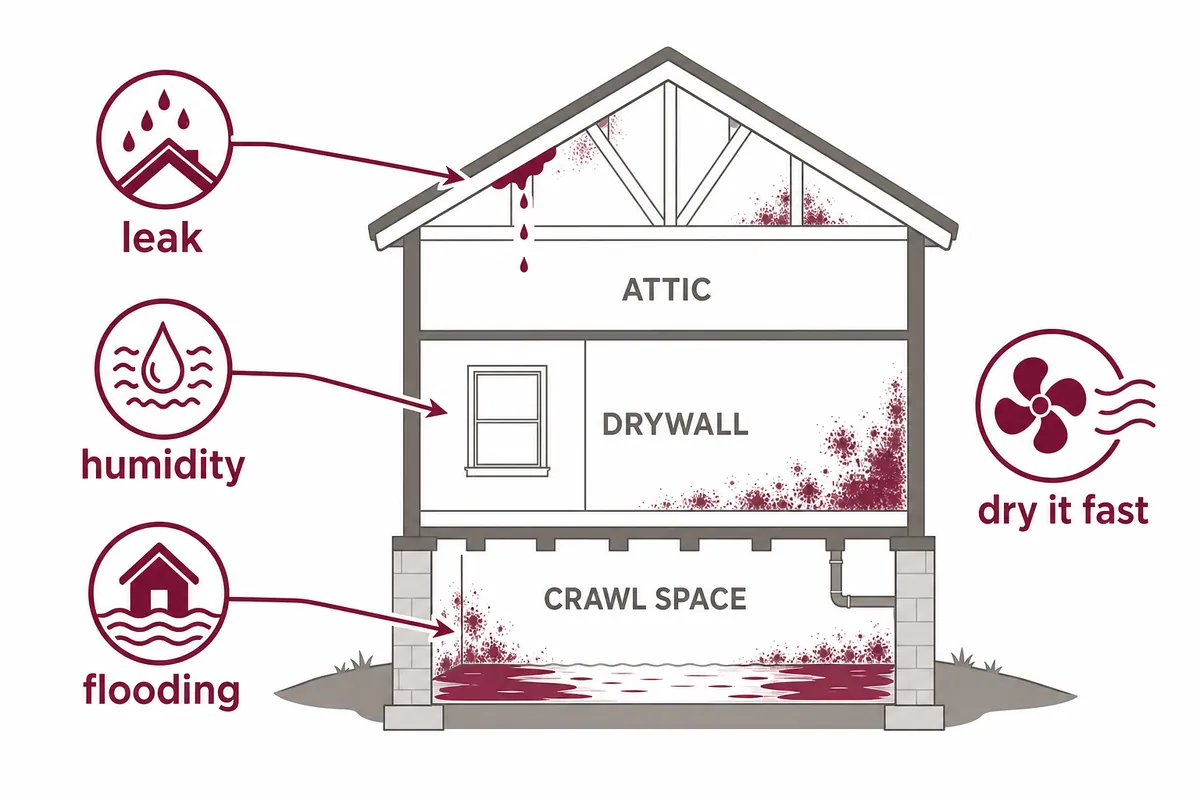
Creek water carries soil, sewage and debris, so treat everything it touched as contaminated. Plan on cutting drywall a couple of feet past the highest stain, bagging soaked insulation, and discarding any carpet or pad that floodwater reached. Framing should be cleaned and dried, and checked with a moisture meter before walls are closed. Then check:
- Crawl space: standing water, a torn or soaked vapor barrier, sagging insulation.
- Basement: wet drywall and carpet along the walls.
- Heating and cooling: don't switch on a furnace, air handler or duct run that was underwater until a technician has checked it.
- Odor: if the house smells stale a week on, some material never dried.
The water damage and mold page covers the first 48 hours. If growth has started, see the typical mold removal costs.
Tell us what you found
Choose the closest match and add a sentence about the room. A mold specialist who works in Nashville will phone you to go over it.